Showing posts with label sculpture installation. Show all posts

Thursday, June 30, 2011

Buddha: Center for Wisdom and Compassion-Tongnyi Nyingjé Ling

In May, I got a call regarding a sculpture I had installed a couple years ago wondering if I could provide another estimate to move and install it again. The sculpture was a stone Buddha that needed to be transported from Vienna, Va. to Berne, NY.  I was driving, there was a lot of static over the phone and  I asked that she email me what she wanted so I could understand the scope of the project. Details in her email included delivery and installation of Buddha asap to the Center for Wisdom and Compassion, a non-profit Buddhist lodge and retreat. There was a special event coming: the visit of His Holiness Sakya Trizin  to bless the lodge and it would be special if the Buddha could be in place to receive his blessing too.  He would arrive in two weeks and they had a limited budget. After a few calls I started to understand their request. I am not a Buddhist, but I honor him and those who believe. I had seen and heard the Dalai Lama speak years ago and his message of peace then is needed even more now. Researching Tibetan Buddhism, I began to see who Sakya Trizin is and what he represents. How could I help?

Unfortunately, because of the budget it was not possible to do the project conventionally. There were a lot of steps and costs: packing/ rigging/transport/installation. However, because of the nature of the project, I found ways to reduce the price. We originally used a small crane to rig Buddha onto the deck but I decided we could do without it and save there. I would make the crate and provide the crew for the de-install in Va. but the largest cost would be transport of that crew to Berne, NY for installation. As our discussions progressed I began to realize that I wanted this project very much to happen. It was becoming personal. I finally suggested I could install Buddha myself if they could have help when the Buddha and I arrived. I believed. I had been preparing for something like this for a long time.

The Buddha is stone and weighs about 1,000 lbs. It was seated in a corner of a living room with the exit door 29" (w) leading to a raised back yard deck. Because of this limitation we packed Buddha outside. We were able to set up my gantry and rig it to the lawn. The gantry is aluminum, very light, with adjustable legs. We put the short leg on the deck and the long leg on the yard with the i-beam level. The rigged crate floated over the rail and landed softly on the grass below.


Friday, December 31, 2010

Sculpture Installation: Craig Kraft


Fall Sculpture planting season is over and as the end of the year slips by I always reflect on the projects I've been lucky enough to be involved in. Installing Art for Artists and individual collectors is a great favorite, there's always strong personal feelings involved and I can't help but be carried by it. Many Artists bear their work like parents and this added complexity, love, is another layer of care and responsibility. Where possible I try to act as they would, as if I were the Artist. Idealistically, this completes the process: the work is born in the studio and I help deliver and place it into the world.

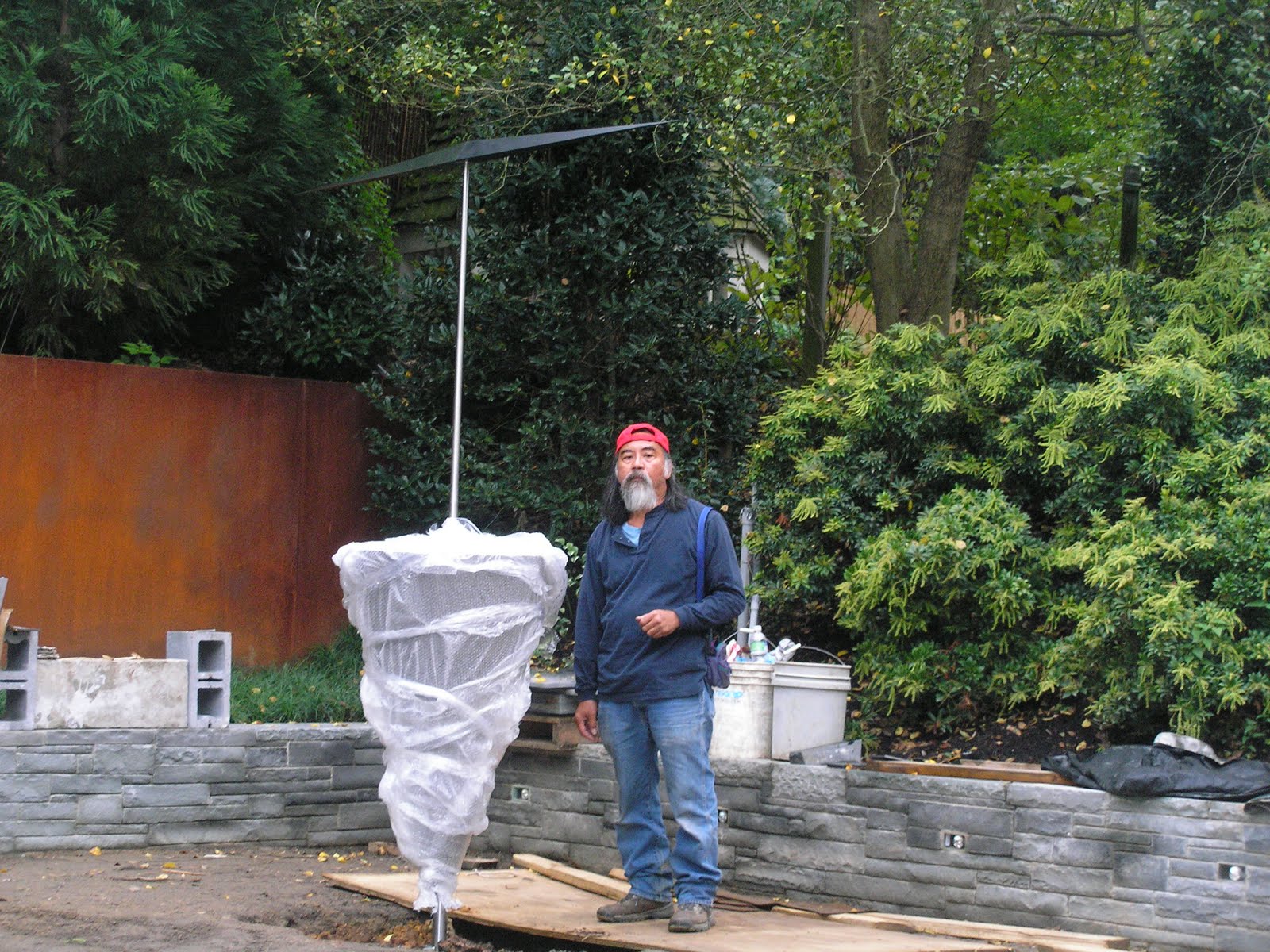
Craig Kraft is a Washington DC sculptor who works with neon. He called me on a recommendation from a local Museum about a sculpture he wanted installed in front of the new Watha T. Daniel Library, logistically it was difficult. The sculpture was large, over 20' tall. Practically, it was almost impossible to truck, it was over wide and over tall. It was an illegal load as is and permits for it would be difficult and expensive. Luckily, the installation site was just 2 blocks away from his studio. He had made the piece outside, near the curbed street and you could almost see where it was going from his front door. We joked that we could get there by pallet jack on the road. It was almost a clear path, we'd just have to miss a few branches and be careful at the stop lights. Unfortunately it was a one way street going the wrong way. After a couple of days thinking about it I made a few calls. Finally with the help of a local company which I use sometimes with rigging and specialized equipment, we came up with a reasonable solution. On an early Saturday morning we arrived on site, rigged the sculpture to a boom forklift, stationed traffic control personnel along the path, taking extra care at the traffic lights and drove it to its new home, twisting it to miss any tree branches that tried to grab it. We were able to bolt to it's new base in two hours.

*video music by Ben Gage and the Mammoth Hunters, excerpt: "So It Goes"

ps: Merry Xmas and a Happy New Year

Sunday, May 2, 2010

Planting Sculptures


Planting sculptures can be as easy as setting something freestanding on the ground, grade or grass or more complicated if the Art needs a base for balance or permanent placement. I like to think of it like the flowers in the garden: will it be an annual or perennial? If an annual, than just setting it outside may be enough, it's accepted that stuff may happen as time and weather changes, a bloom only lasts so long, if a perennial than there are more complicated considerations. For outdoor Art to last season after season the object needs to be understood a little differently. Weather and changing soil conditions are a constant worry. In high winds things can be blown over and in cold climates frost heave can move and topple most sculptures. Ideally, the connection between the Art and earth should have roots, like plants. Generally, a concrete or stone base on grade is a minimum with a foundation or footer below the frost line a step up. The above 1st photo shows two bronze sculptures, Leonard Baskin:
Hephaestus, 65 1/8" X 20 7/8" X 18 7/8" @ 593 lbs. and Jean Ipousteguy: Man Passing Through the Door, 77 1/4" x 54 1/4" X 46 1/2" @ 1359 Lbs. Each is installed on granite pavers over gravel. The Baskin sculpture is attached to a granite base paver with a stainless steel rod/ pin laid on the granite patio dry, without mortar or epoxy. Because of the weight and base design of the Ipousteguy, this sculpture was allowed to sit on the granite patio without pins or base stone. The second photo shows a bronze sculpture by William Tucker: Gymnast 111, 88 3/4" x 60 3/4" x 36 1/8" @ 1032 lbs. It is installed directly on gravel, freestanding, with no pins. If unsure, on heavier,complicated or difficult Art, an engineered solution by a structural engineer or Art Installation Specialist,complete with drawings, details and materials is highly recommended. Remember, sculptures can be large, heavy and dangerous, safety for the Art, Art Handlers and everybody else involved, from client to casual viewer, is first.


The above bronze sculpture is by Raymond Mason: Falling Man, 48 1/4" x 10 1/8" x 27 5/8" @ 865 lbs. It sits on a stainless steel powder coated pedestal I designed. The client asked to see the landscape through the sculpture. The feet of the pedestal sits on a bed of gravel with no concrete foundation. The client understood the sculpture is subject to ground movement, freeze thaw cycle, but they were comfortable with knowing that and had the means to adjust as necessary.


This last sculpture is by Olafur Eliasson: “Large Compass”, it consists of lava rock, steel and aluminum. This was a complicated piece. It came from Germany, and a studio assistant of the artist flew in to oversee it's installation. The sculpture was to be installed in a patio. A landscape architect had already made early decisions as to where and how. Concrete had been poured based on a structural engineers plans and I was brought in to place the sculpture exactly. Logistically, we had to rig the crated object first over limestone steps, the legs of the gantry were set at different heights with the i-beam level. The lava rock weighed a ton and was carved like a pendulum or plumb bob. The design of the handling frame was amazing. A threaded rod was attached to the stone and held to a structural steel beam above it. Turning the rod clockwise like a screw raised the stone enough so that we could partially remove the bottom of the frame it was sitting on. Turning the rod counter clockwise lowered it to the concrete base where we could find perfect plumb and locate where to drill the concrete to pin it. The difficulty was in the final adjustment of the sculpture, by millimeter. The Artists's assistant told me it had to be placed perfectly due north. The lava rock was magnetic and the steel needle attached by a rod in the center of the stone was to be oriented in one direction only. He brought out his compass and we fiddled to get it right. I remember after a while he said OK, but he was still perplexed. I asked what else could we do? What he was using was a professional, German made compass, we had to trust the tool. He looked at me and said he noticed I had an iphone, had I downloaded the compass app by chance? I smiled, apologized, I hadn't.


Here's one of my sculptures, planted in that spot about 8 years ago. Pink Tennessee marble, the top stone is pinned to the bottom stone and it sits on a 7/8" flagstone laid on the tamped garden topsoil. I look at it every now and then to see if the earth moved under it and adjust as necessary.