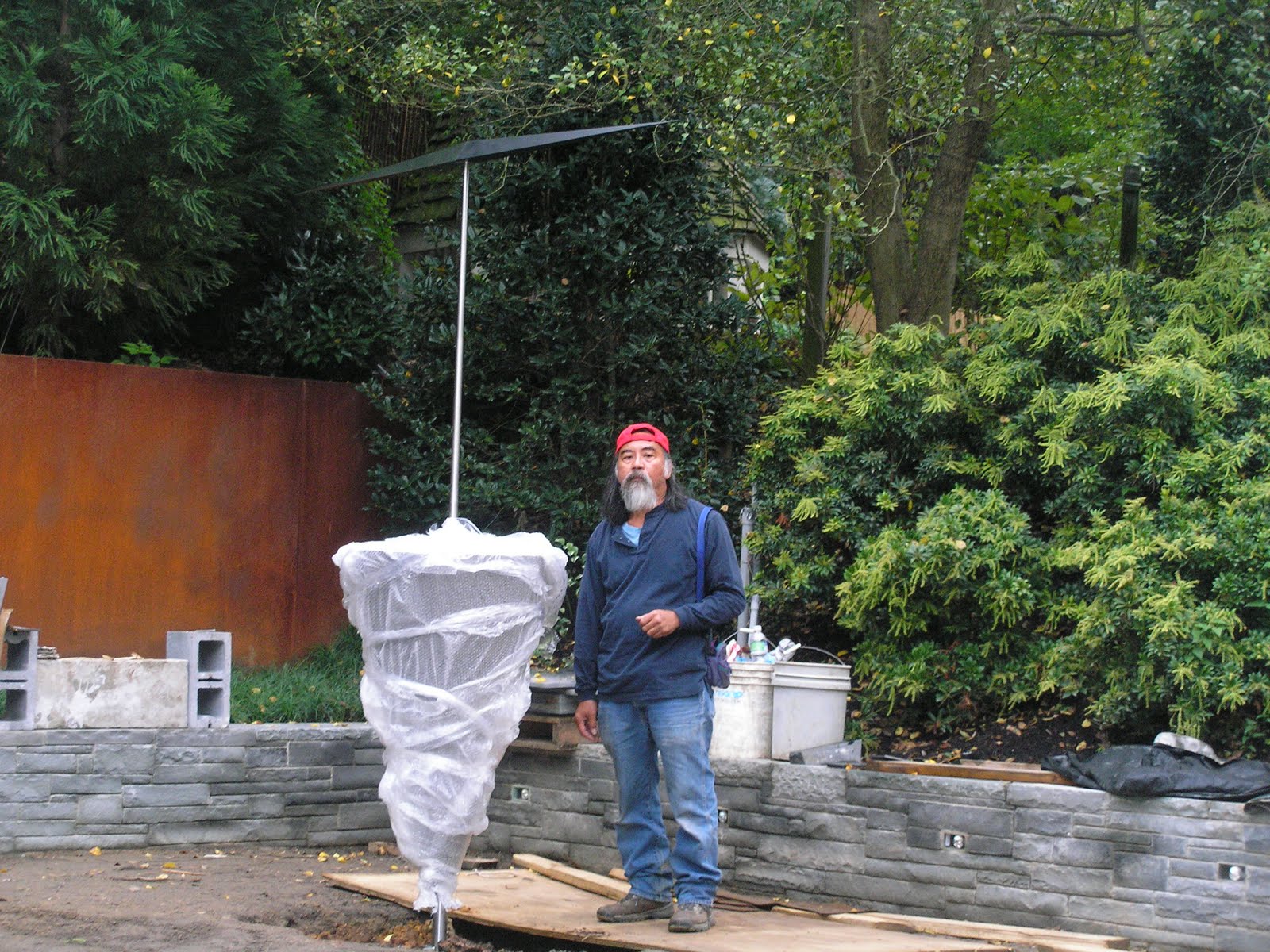
Each project is unique, special and an opportunity to learn about Art. It's a privilege to be involved in responding to the needs of individual pieces, to be in a position to design the total scope of installing Art, especially as scale and difficulty increases. How and where Art fits is an early question and I'm always rejuvenated in that discussion.
The mural above is by Willard Borow, painted in the 1940's, installed in the theater of the John Bassett Moore Intermediate School in Smyrna, Delaware. This is one of two murals installed, both 14' (h) x 10' (w). I was asked to design and fabricate the hanging hardware and be responsible for the installation method. This was special because it came from a client I had done work for years earlier. This was the second part of a greater project. I had previously led the team that de-installed these two murals, among others, including a larger 60' (l) mural in three parts that hung 30' (h) over the theater stage. Photo below.
These murals had been installed for decades in the theater and were badly in need of conservation. Because of limited funds, the mural above the stage was the priority. The two Borow paintings were to be kept in storage until a later date. It was a great surprise to receive the call asking if I would consider finishing the project. How the school found me again was a timely reminder of Art Handling as a personal return business. The school had called the company I had previously worked for and understanding I was no longer employed there they contacted me directly.
The conservation of the Borow paintings were finally undertaken under the guidance of the University of Delaware, Art Conservation Dept. Since the murals could not fit through doors, they were brought into the Theater rolled and re-stretched on the stage floor. Site restrictions included a sloped theater floor, fixed chair rows and 32" aisles. The bottom of the murals were required to be hung above child hand height, placing the top of the murals above 18' (h). Because of the thin aisle width everything was tight. The face of the scaffold was approx. 12" from the wall, just enough room to carry the murals between the wall and scaffold, position the lift to carry the mural to the exact install height and have reasonable reach for tools and hands.
Art in venues outside urban centers, Museums, galleries, auction houses and private collections is a great reminder of their original intention. Sometimes people in the community just love it.
Fall Sculpture planting season is over and as the end of the year slips by I always reflect on the projects I've been lucky enough to be involved in. Installing Art for Artists and individual collectors is a great favorite, there's always strong personal feelings involved and I can't help but be carried by it. Many Artists bear their work like parents and this added complexity, love, is another layer of care and responsibility. Where possible I try to act as they would, as if I were the Artist. Idealistically, this completes the process: the work is born in the studio and I help deliver and place it into the world.
Craig Kraft is a Washington DC sculptor who works with neon. He called me on a recommendation from a local Museum about a sculpture he wanted installed in front of the new Watha T. Daniel Library, logistically it was difficult. The sculpture was large, over 20' tall. Practically, it was almost impossible to truck, it was over wide and over tall. It was an illegal load as is and permits for it would be difficult and expensive. Luckily, the installation site was just 2 blocks away from his studio. He had made the piece outside, near the curbed street and you could almost see where it was going from his front door. We joked that we could get there by pallet jack on the road. It was almost a clear path, we'd just have to miss a few branches and be careful at the stop lights. Unfortunately it was a one way street going the wrong way. After a couple of days thinking about it I made a few calls. Finally with the help of a local company which I use sometimes with rigging and specialized equipment, we came up with a reasonable solution. On an early Saturday morning we arrived on site, rigged the sculpture to a boom forklift, stationed traffic control personnel along the path, taking extra care at the traffic lights and drove it to its new home, twisting it to miss any tree branches that tried to grab it. We were able to bolt to it's new base in two hours.
*video music by Ben Gage and the Mammoth Hunters, excerpt: "So It Goes"
Planting sculptures can be as easy as setting something freestanding on the ground, grade or grass or more complicated if the Art needs a base for balance or permanent placement. I like to think of it like the flowers in the garden: will it be an annual or perennial? If an annual, than just setting it outside may be enough, it's accepted that stuff may happen as time and weather changes, a bloom only lasts so long, if a perennial than there are more complicated considerations. For outdoor Art to last season after season the object needs to be understood a little differently. Weather and changing soil conditions are a constant worry. In high winds things can be blown over and in cold climates frost heave can move and topple most sculptures. Ideally, the connection between the Art and earth should have roots, like plants. Generally, a concrete or stone base on grade is a minimum with a foundation or footer below the frost line a step up. The above 1st photo shows two bronze sculptures, Leonard Baskin: Hephaestus, 65 1/8" X 20 7/8" X 18 7/8" @ 593 lbs. and Jean Ipousteguy: Man Passing Through the Door, 77 1/4" x 54 1/4" X 46 1/2" @ 1359 Lbs. Each is installed on granite pavers over gravel. The Baskin sculpture is attached to a granite base paver with a stainless steel rod/ pin laid on the granite patio dry, without mortar or epoxy. Because of the weight and base design of the Ipousteguy, this sculpture was allowed to sit on the granite patio without pins or base stone. The second photo shows a bronze sculpture by William Tucker: Gymnast 111, 88 3/4" x 60 3/4" x 36 1/8" @ 1032 lbs. It is installed directly on gravel, freestanding, with no pins. If unsure, on heavier,complicated or difficult Art, an engineered solution by a structural engineer or Art Installation Specialist,complete with drawings, details and materials is highly recommended. Remember, sculptures can be large, heavy and dangerous, safety for the Art, Art Handlers and everybody else involved, from client to casual viewer, is first.
The above bronze sculpture is by Raymond Mason: Falling Man, 48 1/4" x 10 1/8" x 27 5/8" @ 865 lbs. It sits on a stainless steel powder coated pedestal I designed. The client asked to see the landscape through the sculpture. The feet of the pedestal sits on a bed of gravel with no concrete foundation. The client understood the sculpture is subject to ground movement, freeze thaw cycle, but they were comfortable with knowing that and had the means to adjust as necessary.
This last sculpture is by Olafur Eliasson: “Large Compassâ€, it consists of lava rock, steel and aluminum. This was a complicated piece. It came from Germany, and a studio assistant of the artist flew in to oversee it's installation. The sculpture was to be installed in a patio. A landscape architect had already made early decisions as to where and how. Concrete had been poured based on a structural engineers plans and I was brought in to place the sculpture exactly. Logistically, we had to rig the crated object first over limestone steps, the legs of the gantry were set at different heights with the i-beam level. The lava rock weighed a ton and was carved like a pendulum or plumb bob. The design of the handling frame was amazing. A threaded rod was attached to the stone and held to a structural steel beam above it. Turning the rod clockwise like a screw raised the stone enough so that we could partially remove the bottom of the frame it was sitting on. Turning the rod counter clockwise lowered it to the concrete base where we could find perfect plumb and locate where to drill the concrete to pin it. The difficulty was in the final adjustment of the sculpture, by millimeter. The Artists's assistant told me it had to be placed perfectly due north. The lava rock was magnetic and the steel needle attached by a rod in the center of the stone was to be oriented in one direction only. He brought out his compass and we fiddled to get it right. I remember after a while he said OK, but he was still perplexed. I asked what else could we do? What he was using was a professional, German made compass, we had to trust the tool. He looked at me and said he noticed I had an iphone, had I downloaded the compass app by chance? I smiled, apologized, I hadn't.
Here's one of my sculptures, planted in that spot about 8 years ago. Pink Tennessee marble, the top stone is pinned to the bottom stone and it sits on a 7/8" flagstone laid on the tamped garden topsoil. I look at it every now and then to see if the earth moved under it and adjust as necessary.
Spring has finally made it. It's a good time to plant sculptures. In the patio, landscape or garden, Art will grow with the flowers, vegetables and trees and begin to achieve a more natural lifespan and life. Freed from climate controlled interiors, objects wear like you or I. The changing light and weather will add dimension and character to the form. With a natural backdrop of unpainted color, birdsong and wind, understanding of the work can suddenly shift from aesthetics to personal adaptive presence, defining the mutual space in private ways a Gallery or Museum cannot design.
One objective criteria of Art is how it survives in the wild, unprotected....
The above video is an illustration of an Antony Gormley sculpture installation. It's made of cast iron, and weighs about 2,000 lbs. Three stainless steel metric pins extend from the feet of the sculpture to beneath the limestone patio paver glued into holes drilled through a re-enforced concrete footer. Because the sculpture was to be installed against a wall, we had to cantilever the i-beam of the gantry and rig a counterweight of stacked palleted stones to prevent the gantry from tipping. This sculpture is made to rust. As it ages, the stains will leave it's mark on the floor and a brown trail will flow where the water goes, expanding continuously the Art's physical reach.
music except: " the Lack of Love," Ben Gage and the Art Handlers
It's been a difficult winter, back to back snowstorms without a break from the bitter cold have kept 3' of snow on the landscape and it's just now melting. In the evening half light the white surface glistens as if it were polished marble. I love thinking I live in a great stone quarry garden. The snow piles softened by wind blast resemble modern sculpture and sometimes I recognize forms I've moved, made or imagined.
The great Artist Louise Bourgeois has created a body of work in a variety of materials including marbles of different colors, especially beautiful white stones. This past year I have been involved in two projects installing several of these sculptures: an exhibition at the Hirshhorn Museum and Sculpture Garden and another for a private collector in Washington DC. These pieces were carved from blocks and left intact as if they had just been cut and lifted from the quarry. You can see the chisel and tooling marks left on the sides of the stone. Her polished forms escape from the top.
In DC, as part of a larger project, a private collector asked if I could de-install, help transport and re-install 2 stone sculptures from their old to new house. The heaviest piece was about 3000 lbs. It was a busy production, we packed them on pallets, loaded the pallets into an air ride box truck, delivered same day to the new residence where we transferred the load onto a small crane truck, which rigged the the pallets to the back porch and our access door to the inside space. The next day we installed them. In the morning when we returned to work on their other pieces, I met the client who asked that they be moved. " The sculpture didn't feel right where they were in the new space." I smiled and said of course I could. When the Art speaks, I try to respond.
*video music excerpt: " Just Us Too." Mack on bass, Ben Gage on guitar.
Sometimes you meet people on this job that change how you think about Art, Artists and stuff. It's unexpected. You see/ handle a piece of Art or meet someone through the work and you're humbled. Somehow things are different after wards. A friend emailed me with a question about a stone sculptor who might need help in moving large blocks of stone in his yard and studio. Because of medical issues he was no longer able to do it himself but the stone needed to be moved and they were wondering if I could help. I arranged a site visit, met the Artist and his wife, studied the stones and asked what they wanted. I have to say I was totally impressed. The stones were beautiful: pink, black and white marbles, all heavy, with a 3,200 lb. block in the yard and a 5,000 lb. rectangle waiting in the studio. The stones had to be moved from where they were in Takoma Park, Md. to California. It would be difficult.
In his living room after discussing the project, I apologized for not being aware of his work. He had been carving for 30 years in one of my favorite Md. neighborhoods. I had lived in a nearby apt. and worked as an art handler in a warehouse a couple blocks away and didn't know him. Surprisingly, a student of my teacher Ken Campbell, who happened to be a next door neighbor, had even been the guy responsible for introducing him to the Art form. Hearing that guys name evoked strong memories of another time. I couldn't believe we had never met. Here was a guy who developed a passion for stone sculpture and built a life around it at his home. Stone carving is not easy, the work is difficult, messy and loud. Imagine hearing a hammer day and night in any neighborhood. It's a big investment especially when you start to work big. It takes effort, money and ambition. Looking at his place I saw he had added an i-beam from a second story floor extending out to his driveway. In his studio there were two i-beams with trolleys and chain falls. He told me he and his wife had moved those stones themselves and I believed him. He began to talk about how he had gotten the stones I had just looked at. The white marble came from a lot he purchased years ago from the Tomb of the Unknown Soldier, a monument in Arlington National Cemetary. He started with 40,000 lbs. and what I saw was what was left. He had sold and carved the rest. The U. of Md. had gotten the other half. I told him I was part of the team that unloaded that stone from a tractor trailer while I was a student there. I had carved blocks of it and had blocks left in my yard in WV waiting. I knew nothing about their origin.
It was a 2 day project in December. Snow, icy rain and terribly cold both days. Trying to hold costs down, I brought one other art handler. I felt if he could bring those stones in, I could take those stones out. We rigged and packed all the stones that would travel on 4 site built pallets the first day. The second day, because of the small driveway, we parked the flatbed tractor trailer going to California in a lot a block away. Using my flatbed truck and a rented boom forklift, we shuttled the palletized stones from the house to the tractor trailer. Afterward, my friend said it was the hardest project we had ever done.
Al Johnson, thank you very much for helping me understand what and why the work.
Art handling is all about balance, understanding the physical presence of the object/ Art and recognizing how to touch it. " ..Do know harm.." is a pretty good mantra, how to do it is the Art: Art handling part. In this business you learn through experience and that is at once the problem and reward. It's a practice, like other professions, and the ideal is something that's mandatory in it's practice. Of course this can be difficult and impossible, especially in groups where consensus is absolutely necessary. As the Art gets as big or bigger than us it becomes less personal and this distance represents the difference in the quality of the Art Handler. Here's a list of possible sculptural materials and their weights. Handling stone sculpture is a good measure. Marble can be 171 lbs. a cubic ft. A life size figure is heavy.
I love the range of Art. Objects are always dissimilar. The Art part of Art Handling is the creative prerequisite. How am I going to do it is something I always begin with. In doubt I let my instincts take over and I stop and reconsider when I have none. I wrote in an earlier post about the National Geographic's: Ceramic Warriors Show. I was primed for it by having just installed a stone Buddha for a private collector. It/ he/ is/was beautiful. I love that part of the world and the imagery / philosophy of both Warriors and Buddha seem culturally supplementary. I'm ripe for Zen, how little I know of it. The Art Handler's responsibility is to be perfect. Handling stuff like this, one after the other, is a barometer of where we're @.
I received a call based on this blog for the first time. I was asked the possibilities of de-installing and then re-installing Buddha from it's present residence to another house not too far away. At the site visit, I verified it was about 1200 lbs. The client and I hit it off, the Buddha was well loved and he wanted an aesthetic treatment commensurate with what Buddha represents. He had already spoken to a rigging company and was apprehensive about their methods. He told me he had gone through the yellow pages in vain and by accident found me. The search had taken some time and he wanted to know if I could do it ASAP as the household move was immanent. There were difficult obstacles in both locations: steps, doors, truck accessibility, object placement, that required a gantry, crane truck, etc. and since I owned all the rigging equipment, that part was not a problem. I told him I would build a handling frame/ pallet on site and I could de-install/ pack/ re-install Buddha in one day. Before I left I asked him how did he get it in the house in the first place. He told me a story about purchasing the Buddha from a dealer in Asia. It was crated, shipped and delivered to his house and left in his front yard. He was wondering what to do about it when he was visited by 15 Tibetan Buddhist monks. Somehow along with himself and another friend they managed to bring the Buddha into the house and install it on it's wood pedestal, but he said it was not easy. I loved that image. As I was leaving, he asked how many guys I would bring? I told him two.
We set up the aluminum gantry with two chain falls on the i-beam and placed Buddha in position. We wrapped two straps on either side of the figure with opposite chokes, careful where the tension would touch the body and hooked them to the chain falls. In slow motion we raised each chain fall by chain link feeling the balance and adjusting as needed. Without a sound the seated Buddha rose. In the air it floated perfectly level. The client looked at me and said something like, .." You made it levitate."
Videomusic: excerpt.." Perhaps it Matters." Mack on bass, Ben Gage on guitar Merry Holidays
I'm a carver of stone, poems and guitar. As a result of studying how to move and manage my own sculptures, I ended up handling art for a living, from King Tut to the Boller and Chivens 16-inch Cassegrain telescope @ the new Air and Space Museum Observatory in Washington DC. I love difficult unusual projects. Here are a few stories about some of them.