Saturday, April 30, 2011
Mint Museum: Stanislay Libensky and Jaroslava Brychtova
Occasionally, you're asked to be involved in a project that comes to you based on goodwill accumulated over years of good service. I had done work for the Mint Museum in Charlotte, NC but had not been back there for years. Through mutual friends, Bonsai Inc., I was asked if I wanted to be involved in de-installing and then re-installing a large scale glass sculpture by the Czech artists Stanislay Libensky and Jaroslava Brychtova. The Museum was relocating to a new building and this was among the last pieces to be moved. Because of the complexity of the project scope, they wanted someone who could troubleshoot problems and communicate practical answers, having me on board eased their worries. It was a commissioned piece made of 10 cast glass panels, each about a thousand pounds. There were two rows of five panels, the top five were bolted to an i-beam welded to structural steel in the ceiling and the bottom five were bolted to a steel plate on the floor. About 1/4" separated the two rows of shapes and both rows were in perfect plane from top to bottom and plumb side to side. Though difficult, de-installing the piece was the easier part. Confirming how to understand how each glass panel related to each other to make the whole was the question and then transferring this data to the new site, on the third floor of the new building, the challenge. Where it was to be installed, construction crews had already set the i-beam in the ceiling and a steel plate was epoxied to the floor. However, only the holes in the above i-beam were drilled. The construction crew did not want to be responsible for the bolt holes in the floor plate, since we were working inside 1/16" tolerance. That was the Art part. I had fretted how to locate the holes, and since it was my responsibility, thought about lasers, fancy tools and other esoteric measurement schemes. We had 24 holes to drill and each drilled hole had to be tapped square to the floor. They all had to be perfect. In the end I decided simple was best. I had a machinist make an aluminum plug the same diameter as the bolt hole in the ceiling i-beam with a 1/8" hole drilled dead center in the plug. A string line threaded through the hole and a plumb bob was lowered to the plate on the floor. It was about 14' between floor and ceiling. We all watched the plumb bob spin until it finished it's dance pointing to exact dead center. It was perfect.
Thursday, March 31, 2011
Bronze Sculpture Installation
The weather has been playing tricks, it's early Spring and outside there's snow and icy rain. If you work outside then the work can be difficult and miserable, a good forecast can be wishful thinking. In scheduling outdoor art installations, there's too many fixed factors that prevent rescheduling: coordination of rental equipment, material deliveries and the crew. Sometimes, you just have to put on your warmest clothes and a raincoat and make the best of it.
In this project, the client had a bronze sculpture in need of conservation, pinned to a stone base about 6' tall that was cracked and in need of replacement. A design for a new limestone base was accepted and manufacture of the base started. As a first step, we had to de-install the sculpture, rig it to the ground for the conservators to do their magic and remove the old base. Because the actual work site was out of town for myself and the crew and all the steps needed to start the project was already in motion, we decided to go ahead and start. The rain was a problem. I had brought extra rain coats and gloves and we soaked thru all of them. I had the crew sit in the truck with the heater on high for a little bit of comfort in between the de-install steps with our gloves on the heater vent trying to dry. It was actually a lot of fun. The crew was great, when you work with people you love, the work can be creative and inspiring. The rigging of the sculpture went perfect. For safety, we waited until the next day to dismantle the base. We would need to use electric hammer drills to break it up. The forecast was suppose to be better.
Tuesday, February 22, 2011
Delaware Art Museum: Al Held, " Rome 11"
I've been thinking about large painting installation since my last post and I realize it's not often you get the chance to work in that scale and scope. Size is the problem for the artist and collector. Who has studio space and help to work that large and who has a wall to display it? Generally, Museums have their own staff to handle the work and the few Art Handling Specialists who are lucky enough to be involved, are more often assistants in the process and not the lead in the project. For me, figuring out how, is the lucky part. Each step must be reasonable, cost effective and visually self explanatory with safety for the Art and crew the primary starting point. Viewers should be able to see, understand and make sense of the progression of the installation. Indeed, the installation is part of the "Art Show."
Monday, January 31, 2011
Mural Installation: John Bassett Moore School
Each project is unique, special and an opportunity to learn about Art. It's a privilege to be involved in responding to the needs of individual pieces, to be in a position to design the total scope of installing Art, especially as scale and difficulty increases. How and where Art fits is an early question and I'm always rejuvenated in that discussion.
These murals had been installed for decades in the theater and were badly in need of conservation. Because of limited funds, the mural above the stage was the priority. The two Borow paintings were to be kept in storage until a later date. It was a great surprise to receive the call asking if I would consider finishing the project. How the school found me again was a timely reminder of Art Handling as a personal return business. The school had called the company I had previously worked for and understanding I was no longer employed there they contacted me directly.
Friday, December 31, 2010
Sculpture Installation: Craig Kraft
Fall Sculpture planting season is over and as the end of the year slips by I always reflect on the projects I've been lucky enough to be involved in. Installing Art for Artists and individual collectors is a great favorite, there's always strong personal feelings involved and I can't help but be carried by it. Many Artists bear their work like parents and this added complexity, love, is another layer of care and responsibility. Where possible I try to act as they would, as if I were the Artist. Idealistically, this completes the process: the work is born in the studio and I help deliver and place it into the world.
Craig Kraft is a Washington DC sculptor who works with neon. He called me on a recommendation from a local Museum about a sculpture he wanted installed in front of the new Watha T. Daniel Library, logistically it was difficult. The sculpture was large, over 20' tall. Practically, it was almost impossible to truck, it was over wide and over tall. It was an illegal load as is and permits for it would be difficult and expensive. Luckily, the installation site was just 2 blocks away from his studio. He had made the piece outside, near the curbed street and you could almost see where it was going from his front door. We joked that we could get there by pallet jack on the road. It was almost a clear path, we'd just have to miss a few branches and be careful at the stop lights. Unfortunately it was a one way street going the wrong way. After a couple of days thinking about it I made a few calls. Finally with the help of a local company which I use sometimes with rigging and specialized equipment, we came up with a reasonable solution. On an early Saturday morning we arrived on site, rigged the sculpture to a boom forklift, stationed traffic control personnel along the path, taking extra care at the traffic lights and drove it to its new home, twisting it to miss any tree branches that tried to grab it. We were able to bolt to it's new base in two hours.
*video music by Ben Gage and the Mammoth Hunters, excerpt: "So It Goes"
Sunday, May 2, 2010
Planting Sculptures
Planting sculptures can be as easy as setting something freestanding on the ground, grade or grass or more complicated if the Art needs a base for balance or permanent placement. I like to think of it like the flowers in the garden: will it be an annual or perennial? If an annual, than just setting it outside may be enough, it's accepted that stuff may happen as time and weather changes, a bloom only lasts so long, if a perennial than there are more complicated considerations. For outdoor Art to last season after season the object needs to be understood a little differently. Weather and changing soil conditions are a constant worry. In high winds things can be blown over and in cold climates frost heave can move and topple most sculptures. Ideally, the connection between the Art and earth should have roots, like plants. Generally, a concrete or stone base on grade is a minimum with a foundation or footer below the frost line a step up. The above 1st photo shows two bronze sculptures, Leonard Baskin: Hephaestus, 65 1/8" X 20 7/8" X 18 7/8" @ 593 lbs. and Jean Ipousteguy: Man Passing Through the Door, 77 1/4" x 54 1/4" X 46 1/2" @ 1359 Lbs. Each is installed on granite pavers over gravel. The Baskin sculpture is attached to a granite base paver with a stainless steel rod/ pin laid on the granite patio dry, without mortar or epoxy. Because of the weight and base design of the Ipousteguy, this sculpture was allowed to sit on the granite patio without pins or base stone. The second photo shows a bronze sculpture by William Tucker: Gymnast 111, 88 3/4" x 60 3/4" x 36 1/8" @ 1032 lbs. It is installed directly on gravel, freestanding, with no pins. If unsure, on heavier,complicated or difficult Art, an engineered solution by a structural engineer or Art Installation Specialist,complete with drawings, details and materials is highly recommended. Remember, sculptures can be large, heavy and dangerous, safety for the Art, Art Handlers and everybody else involved, from client to casual viewer, is first.
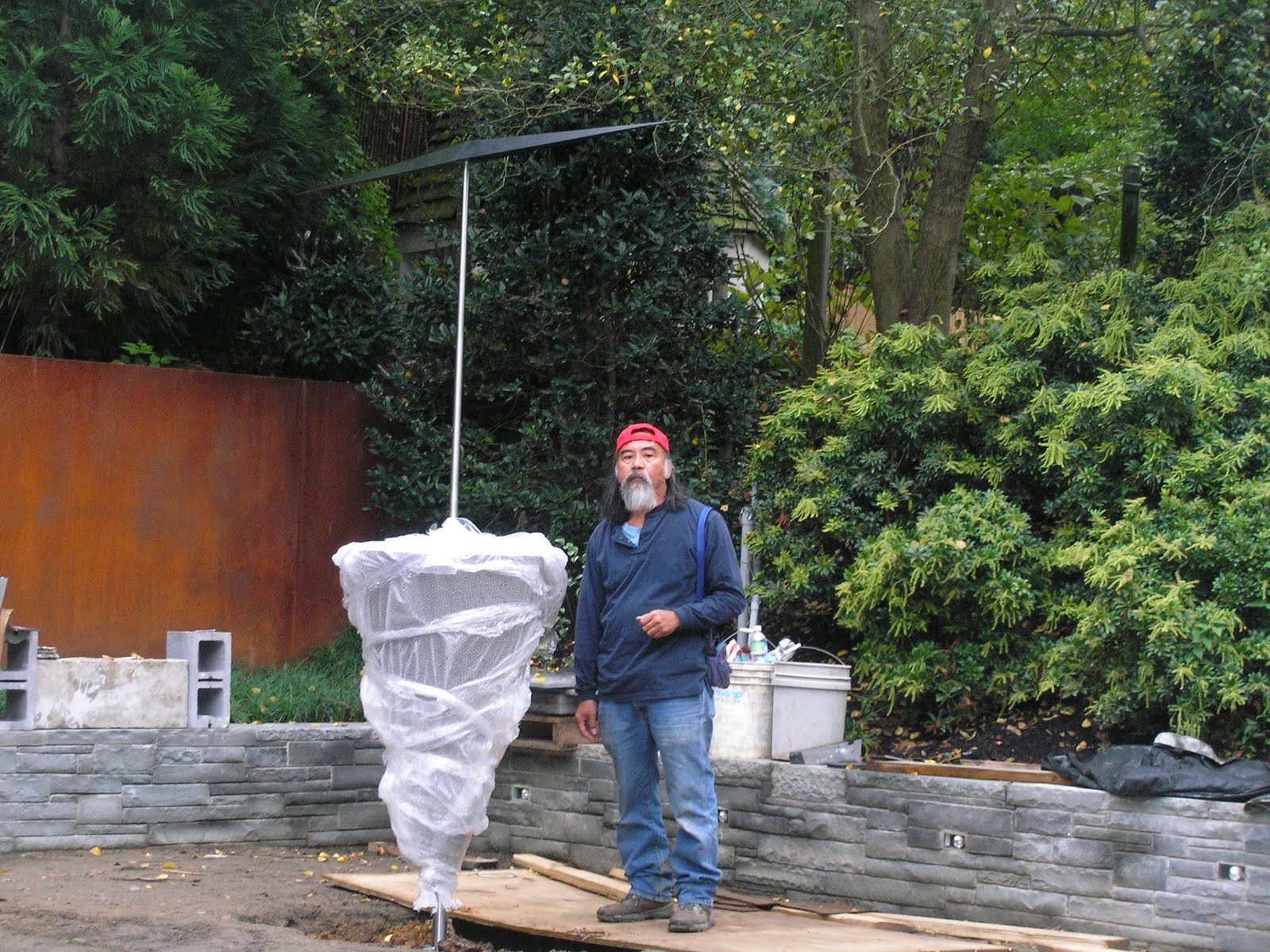
This last sculpture is by Olafur Eliasson: “Large Compassâ€, it consists of lava rock, steel and aluminum. This was a complicated piece. It came from Germany, and a studio assistant of the artist flew in to oversee it's installation. The sculpture was to be installed in a patio. A landscape architect had already made early decisions as to where and how. Concrete had been poured based on a structural engineers plans and I was brought in to place the sculpture exactly. Logistically, we had to rig the crated object first over limestone steps, the legs of the gantry were set at different heights with the i-beam level. The lava rock weighed a ton and was carved like a pendulum or plumb bob. The design of the handling frame was amazing. A threaded rod was attached to the stone and held to a structural steel beam above it. Turning the rod clockwise like a screw raised the stone enough so that we could partially remove the bottom of the frame it was sitting on. Turning the rod counter clockwise lowered it to the concrete base where we could find perfect plumb and locate where to drill the concrete to pin it. The difficulty was in the final adjustment of the sculpture, by millimeter. The Artists's assistant told me it had to be placed perfectly due north. The lava rock was magnetic and the steel needle attached by a rod in the center of the stone was to be oriented in one direction only. He brought out his compass and we fiddled to get it right. I remember after a while he said OK, but he was still perplexed. I asked what else could we do? What he was using was a professional, German made compass, we had to trust the tool. He looked at me and said he noticed I had an iphone, had I downloaded the compass app by chance? I smiled, apologized, I hadn't.